Ghosts
Uncle SilasGhosts in Uncle Silas are not simply apparitions to be either believed or dismissed: they are family lore, disturbing sounds, religious speculation, and a vocabulary for fears whose causes remain obscure. From the stories attached to Knowl to the oppressive spaces of Bartram-Haugh, the ghostly repeatedly makes the past seem present while leaving open whether the experience is supernatural, imagined, or deliberately produced by people.
Legends and reported apparitions
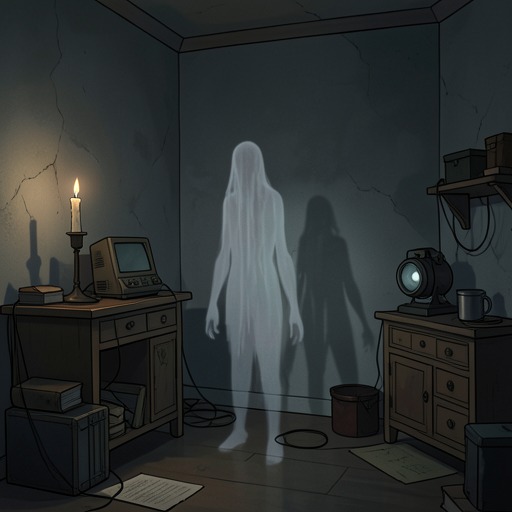
Knowl’s haunting traditions give its old house a history heard as much as seen. Rachel Ruthyn, remembered as a beauty from Queen Anne’s time, is said to walk at night after the death of Colonel Norbrooke, who was killed in the Low Countries. No one sees her: the legend is built from the sound of high heels, rustling brocade, sighs near bedroom doors, and, on stormy nights, sobbing. Her absence from sight makes the house seem inhabited by a sorrow that has outlasted its original circumstances.
A second figure, the “link-man,” is described in markedly different terms. He is reportedly visible but silent, a dark-clothed man carrying a torch that usually smoulders red. The house servants’ story makes the torch’s rare flare an omen: when he whirls it above his head and it bursts into flame, a crisis or calamity is expected. The account gives the apparition a place in a shared system of interpretation, one in which an unusual sight is treated not just as a ghostly occurrence but as a warning about what is to come.
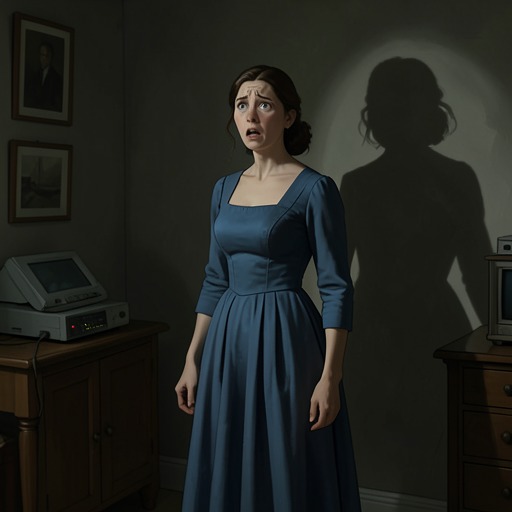
The household’s legends acquire an unsettling immediacy when Madame de la Rougierre tells Maud and Mary Quince that someone has walked in the gallery outside her bedroom. Madame says she heard rustling clothing and long breaths, and that, after she called out, the unseen person turned and approached her with unnatural speed. The report frightens Maud and Mary, but Maud also observes that the first intense effect of ghost stories soon subsides: Madame’s account becomes one more tale among the others. The novel thus shows fear being conveyed through narrative, even as repetition can domesticate it.
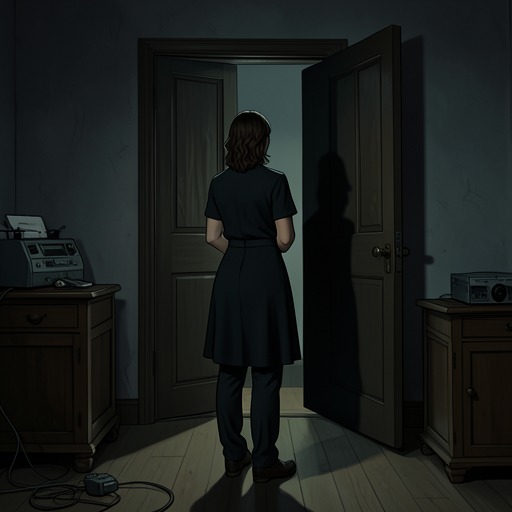
Maud later wakes to a darkened room and hears a soft step, a rustle, and breathing in the gallery. Thinking first of Mary Quince, she opens her door and calls to her, but receives no answer; the noises move away toward the upper staircase. She retreats in fear. The episode resembles Madame’s story, yet it is not confirmed as the work of a ghost: Mary Quince had returned and gone to bed before Maud awoke. The unexplained sounds retain their force precisely because the scene supplies no conclusive supernatural explanation.
Fear, suggestion, and human agency
At Church Scarsdale, Madame turns ghost stories into a way of unsettling Maud. She points to the darkness, the trees, the isolation, and the Ruthyn graves, then asks whether Knowl is haunted. When Maud asks her to stop, Madame claims to have seen a ghost the previous night: an old, wicked-looking figure with large white eyes, sitting with its arms around its knees. Maud recognizes the tale as an attempt to frighten her, but the exchange also reveals how readily Madame makes the supernatural serve her own purposes. Her account is presented as a story she tells, not as independent proof that a ghost appeared.
Maud struggles to explain why Madame frightens her. She admits that Madame does not threaten her outright; instead, something about her seems “ghosty.” Lady Knollys answers that the quality may be “devilish,” and suspects that Madame has been pretending to be ill to avoid her. Maud senses that Lady Knollys’s judgment rests on knowledge from the past that she has not yet disclosed. The exchange ties ghostliness to uncertainty about a living person: an unsettling impression may register danger without revealing its source.
Lady Knollys explicitly tells Maud that they must not talk of ghosts because Maud is superstitious and might be frightened. Her reassurance marks a contrast between Maud’s vulnerability to suggestion and her cousin’s deliberate refusal to intensify it. Yet the subject does not disappear. Soon Lady Knollys studies a small portrait of a golden-haired boy and wonders whether he is sincere, calling him mysterious. The transition from ghost stories to a portrait associates supernatural unease with the broader problem of reading appearances, without establishing that the boy is himself a ghost.
Swedenborgian belief and the afterlife
The supernatural also enters through religious teaching. A man speaking to the young Maud invokes Swedenborg to claim that he can see beyond a wall and knows that Maud’s mother is not in the place Maud imagines. Maud hears the name as something like that of a fairy-tale magician and becomes frightened. The account presents Swedenborgian revelation through a child’s uncertain understanding: a claim about spiritual knowledge can sound to her like magic, even when it is offered as reassurance about the dead.
When Maud asks where her mother has been taken, the speaker answers that the home she seeks can be reached only through the “gate of death,” toward which everyone is moving. He describes death as an eventual opening through which the dead may enter and be refreshed, invoking Hagar’s eyes being opened in the wilderness. Ghosts and spirits therefore belong to a religious framework as well as to household superstition: the discussion is concerned not only with apparitions but with death, reunion, and the possibility of knowledge beyond the visible world.
Doctor Bryerly’s visits to Knowl intensify Maud’s unease about that framework. During one visit, he meets her father twice in private, while Mrs. Rusk complains about the Swedenborgians and describes Bryerly as a ghostlike presence moving in and out of the room. Maud stays awake wondering what connects him to her father. She feels that their religious convictions alone cannot account for her father’s agitation, and begins to detest Bryerly because his presence seems to bring pain to someone she loves. Later, on a stormy evening, she asks who the Swedenborgians are and whether their belief is good and true or heresy and witchcraft. Her fear records a crisis of confidence rather than a settled verdict on the faith.
Haunted architecture and material explanations
Bartram-Haugh extends the ghostly atmosphere from stories into the physical arrangement of the house. By moonlight, Maud first sees its elaborate white façade, decorated entrance, and grand proportions, but also its stained, moss-grown front and storm-felled trees. Weeds cover the avenue and courtyard; the old house looks deserted despite its scale and richness. This contrast makes the building appear at once imposing and neglected, a setting in which unease can attach itself to rooms and corridors before any apparition is reported.
Inside, Maud and Milly find locked rooms, closed shutters, and orders not to disturb what lies behind them. High hatches interrupt corridors and galleries, with some locked across the passage. The physical barriers limit where the girls can go and what they can inspect; the house’s mysterious character is therefore not only an effect of ghost stories but also of controlled access. In the upper parts of the building, the girls come upon a chamber overlooking a dark inner quadrangle, where dirt, moss, and undisturbed weeds mark how little the space is used.
The chamber recalls the death of Mr. Charke. Maud identifies it as the room where he killed himself, pointing to panelling pulled from the wall; Milly does not know the story and asks who Charke was. The disclosed history changes the room’s meaning: what first seems sinister because of its darkness and neglected courtyard is also connected to a specific death and the household’s past. The scene locates horror in remembered human events without turning them into evidence of a haunting.
Later, during Maud’s confinement, Madame presents an inner courtyard as if it belonged to a hotel. Maud recognizes it as the court of Bartram-Haugh, exposing the supposed change of setting as deception. When she tries to leave her bedroom, she finds bars fixed into the window frames and windows screwed shut; the room has been made into a prison. The bars and altered fittings supply a concrete explanation for what might otherwise be read as uncanny confinement. Bartram’s most frightening secrets are not proved to be supernatural: people have made the house’s hidden spaces and barriers part of a plan.
Uncertainty and narrative significance
The ghost motif persists because the book distinguishes different kinds of claim without resolving every experience. Rachel Ruthyn and the link-man belong to local tradition; Madame supplies a frightening personal account; Maud encounters unexplained sounds; and Swedenborgian belief gives death and spiritual perception a theological dimension. These are not interchangeable forms of evidence. The legends are reported by the household, Madame’s apparition is her own assertion, and Maud’s nocturnal experience remains unexplained.
That uncertainty also makes ghostliness a way to describe the limits of knowledge. Maud fears that Doctor Bryerly has an influence she cannot understand, senses danger in Madame before learning what Lady Knollys knows, and encounters a house whose locked passages and altered rooms conceal human actions. The supernatural language gives shape to her apprehension, but it does not tell her reliably who is responsible or what has happened. The novel’s most consequential reversals therefore come when apparently uncanny impressions meet material evidence: a room’s history, a barred window, or a deceptive account of where she is.
At the end, Maud questions whether her uncle’s religion ever possessed real sincerity. She imagines temptation as a gradual approach and considers the possibility that he once believed himself righteous while coveting things he feared to lose. Her reflection turns religious language toward moral judgment rather than spectral proof. Ghosts, spirits, and the afterlife remain part of the book’s atmosphere and its characters’ thought, but the central danger lies in the living: in deception, concealed motives, and the power to make a house feel haunted by controlling what others can see.